

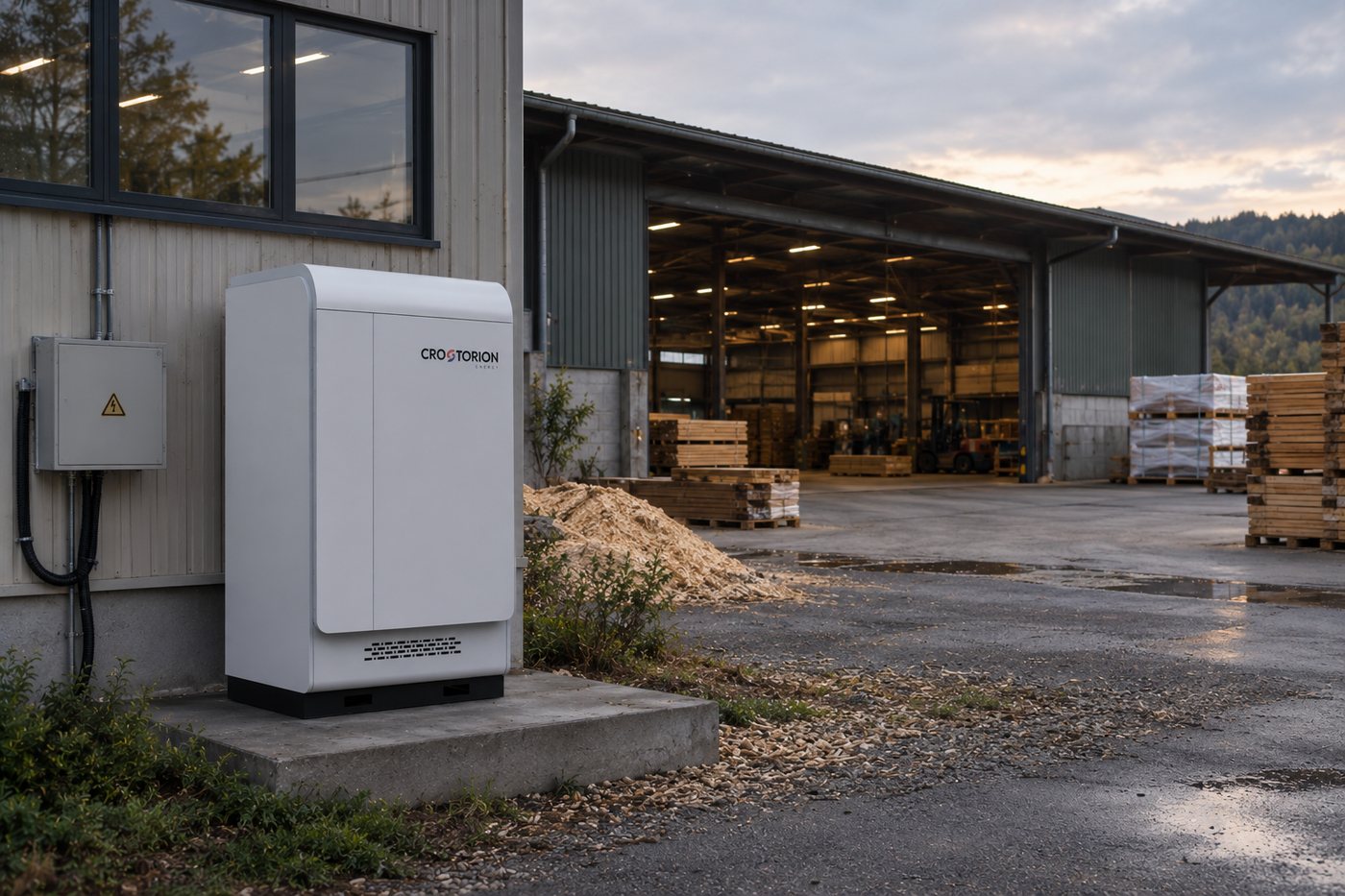
The battery on your site.
The investment on ours.
We finance, install, own and operate the storage system at your site. You put up no capital — and the net benefit it produces is measured against your own meter and shared. For industry, hotels, offices and logistics.
Storage as a service, not a purchase
ESaaS isn't a way to finance hardware — it's a running service with people behind it. Here's what that means for you, concretely.
A smaller bill, from the first month
The battery charges in your low-tariff block, discharges into your own consumption when electricity is expensive, and holds down the peak that sets your grid charges. Nothing changes in how the site runs — the bill simply comes in lower.
There is no loan to service and no invoice for the hardware. The system is paid for out of the benefit it creates, and an agreed share of that net benefit is the only thing you pay. No benefit in a period, nothing to pay for it.
A running system, not a pallet of hardware
We size the system from your real consumption, install and commission it with our own engineers, watch it 24/7, and service it for the life of the contract — with a contractual 24-hour response window for warranty cases.
If something fails, the repair, the parts and the lost time are our cost, not yours.
A battery that pays its own way
When your site doesn't need it, the battery trades and supports the grid under our own electricity-trading licence. That income is what lets us carry the investment instead of you — and why we care, every single day, that your system runs perfectly.
Every action shows up in your portal: what you saved, and when it earned.
Everything on this list, inside one agreement.
No setup charges, no service call-out fees, no software licences on top. If it's on this list, it is covered — there is nothing to invoice separately.
Sizing from real data
A study of your actual consumption decides the system size — you never pay for capacity you don't need.
Installation & commissioning
Delivered, fitted and brought online by our own engineers, on your schedule — one visit for most sites.
The Storion platform
Daily optimisation, the client portal and the app — your savings and the battery's market work, visible in real time.
Monitoring, service & warranty
24/7 remote monitoring, maintenance and repairs for the life of the contract, with a 24-hour response window for warranty cases.
Backup capability
The system can carry your essential loads through an outage — switchover is automatic.
Market access
Registration, trading and settlement under our own electricity-trading licence — the part you couldn't buy separately even if you wanted to.
One battery, three jobs
A battery that only shaves peaks is underused. Under ESaaS the same system stacks three kinds of value — and because all three are shared on the same terms, we only do well when the system does.
The case is built on the first job alone. Your proposal sizes the system on behind-the-meter value only — the saving on your own bill — so the investment has to stand up before a single euro of market revenue is counted. The market layer is upside on top of that, and it is the part a hardware supplier cannot offer you at all. Both are shared on the same agreed percentages, both are measured before anything is invoiced, and a period with no net benefit costs you nothing. You see all of it in the client portal: what you saved, and when the battery was earning.
How the market side worksYour part is one signature and one share
You
- Provide the spot — a wall, a corner of the yard, a place by the building.
- Sign one contract — hardware, software, service and market access in a single agreement.
- Share the net benefit — an agreed share of what the system measurably saved and earned, less the documented costs of producing it. Bill savings settled monthly, market earnings annually.
- Watch it work — savings and market activity, live in the portal.
Crostorion
- Finance & own — the system is on our balance sheet, not yours.
- Install & commission — our own engineers, on your schedule.
- Operate & optimise — the Storion platform runs it every day, automatically.
- Service & respond — monitoring, maintenance and a 24-hour warranty response window.
- Trade within our licence — the market layer, and the risk that comes with it.
Four things the contract fixes
Most of the industry keeps contract terms behind a sales call. These are ours, from the agreement itself.
Ten-year term
Fixed, counted from the commercial operation date — the day the system is installed, tested, connected and ready to run.
We own it throughout
The system belongs to us or to the financier for the whole term, and stays removable equipment — never part of your building, your assets or your estate.
Settled on measured data
Bill savings monthly, market earnings annually, from bills, metering, EMS and market data — with a window to object and an independent expert for anything disputed.
A defined ending
At the end of the term we agree in writing on an extension, a buy-out or removal. If we remove it, we leave the site safe and usable.
Your share, and the method used to measure the benefit, follow from your load profile — both are in your proposal, within two business days of your enquiry.

Commercial and industrial sites, 100 kWh to 1 MWh+
ESaaS is a business model. It needs a metered site with a tariff structure worth optimising and enough load to absorb what the battery discharges — which is why our sizing engine models four kinds of site, and none of them is a house.
Industry
Process load with a hard billing peak — the case where peak-power reduction alone usually carries the project.
Hotels & resorts
Strong seasonality and an evening peak; out of season the same asset works the market instead.
Offices & retail
A daytime curve that fits solar badly and tariff windows well, with backup for the parts that cannot stop.
Warehousing & logistics
Cold storage and night shifts — flat, predictable load, which is the easiest kind to schedule against.
Home storage is sold and installed, not leased: a household system is too small to carry the metering, market and settlement machinery this model runs on. Home batteries are here.
Three steps to a running system
Send twelve months of bills
Bills or a 15-minute metering export, plus your grid connection capacity. That is everything the sizing needs — we read the tariff, the billed peak and the consumption out of them ourselves.
Get a numbered offer
Recommended power and capacity, expected annual saving, payback, expected cycles and your share of the benefit — on a private link with its own password, within two business days.
We install. It starts saving.
Our team fits and commissions the system, the platform takes over, and the savings begin with the first bill.

Things people ask about ESaaS
What's the catch?
There isn't a hidden one. The model works because the battery earns twice — the saving on your bill and the market work it does through our trading licence — and we are paid out of both. We earn only when the system earns, so it is in our interest that it runs perfectly.
Who owns the system?
Storion Energy d.o.o., or the financier behind the project, for the whole term. The system stays separable, removable equipment — it never becomes part of your building, your assets or your estate, which is also what protects it if either side runs into trouble.
What happens when the contract ends?
The term is ten years from the commercial operation date. When it expires we agree in writing on an extension, a buy-out or removal — and if we remove the system, we leave the site safe and usable.
What if something breaks?
That's our problem, not yours. Monitoring, maintenance and warranty are inside the agreement, with a contractual 24-hour response window for warranty cases.
Can I end up paying more than I saved?
No. What you pay is a share of a benefit that has already been measured against your reference cost — if there is no benefit in a period, there is nothing to share. Market risk sits on our side of the contract.
Can I see what the battery is doing?
Always. The client portal shows your savings in real time — and marks exactly when the battery was working for the market.
Start your own project
Tell us about your project and we'll size a system and reply within two business days.